A maintenance calendar for a Valencia flat, season by season
Last updated: 26 September 2026
Most repairs in a rented flat arrive on predictable dates: the air conditioning in the first hot week, the boiler on the first cold night, the terrace drain in the first autumn storm. This is the maintenance calendar Valencia flat owners can work from: what to check in each season, what to check at every changeover, and which dates the law sets for whole buildings.
Why a calendar works better than a repair list
A maintenance calendar moves work from the week something breaks to the quiet weeks before it is needed. Valencia's climate makes the timing easy to plan: AEMET's long-term averages for the city show August highs of about 30 °C, January lows of about 7 °C, relative humidity of around 65% all year, and the most rain in September and October.
On mid-term lets of 1 to 11 months, each changeover is also a window for the jobs below.
The calendar at a glance
A Valencia flat needs 4 seasonal rounds of checks, plus a fuller one at every tenant changeover.
Season | Main tasks |
|---|---|
Spring (March to May) | Service the air conditioning; repair shutters; clear balcony drains |
Summer (June to August) | Ventilate and check for damp; run taps and flush toilets in an empty flat |
Autumn (September to November) | Clear terraces, gutters, downpipes and drains; check sealant; test the heating; service the boiler and termo; check gas hoses |
Winter (December to February) | Watch for condensation and mould; test smoke and carbon monoxide alarms |
All year | Descale taps and appliances; check the wifi; track legal inspection dates |
Spring: air conditioning before the heat
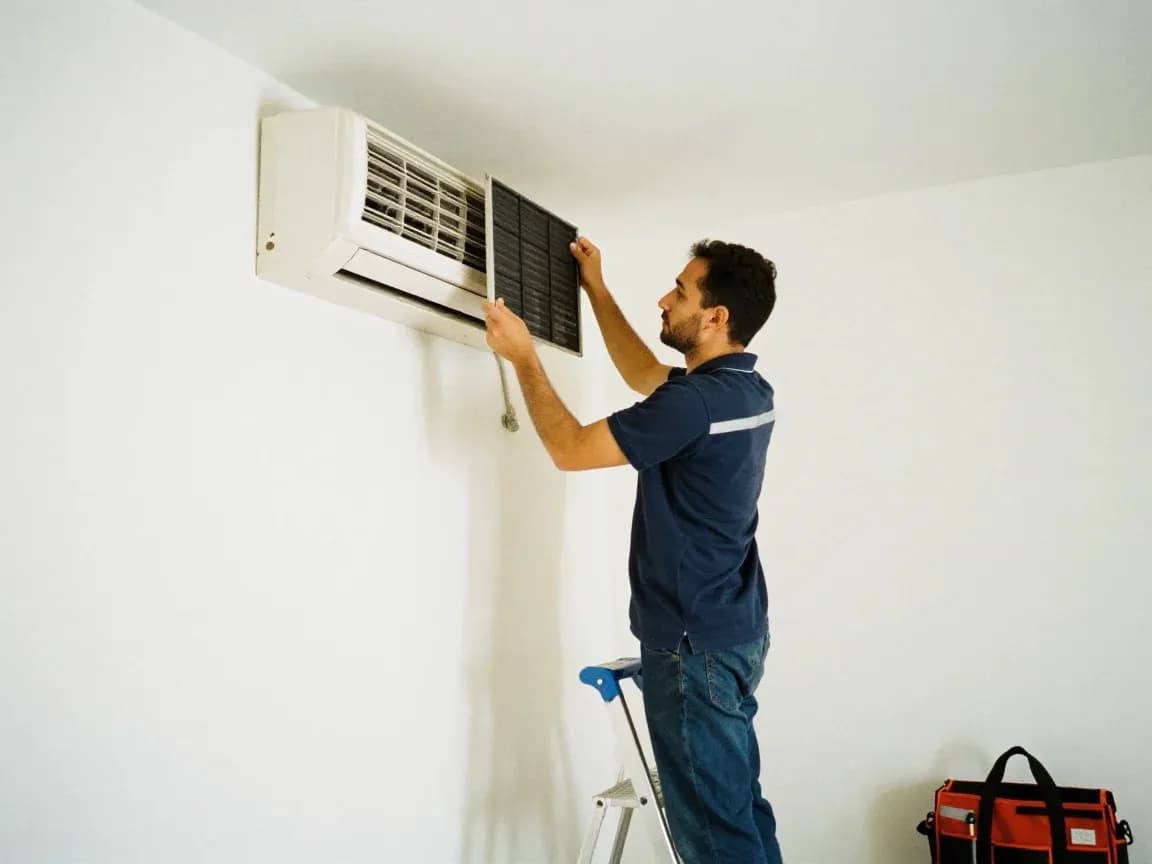
Spring is the time to service the air conditioning, before the first hot week turns a check into an emergency call. Clean the filters, check the unit cools, and make sure the condensate drain runs freely, or it will drip onto the balcony below.
Spain's thermal installations regulation (RITE) sets minimum service intervals for homes: 4 years for an air-conditioning unit of up to 12 kW, 2 years for a gas wall boiler and 5 years for a gas water heater of up to 24.4 kW, plus the manufacturer's schedule. In a rented flat, a yearly air-conditioning check is the sensible rhythm.
Spring is also the season for persianas: a frayed shutter strap is easier to fix in April than in August.
Summer: humidity, ventilation and empty weeks
In summer the main risk inside a Valencia flat is trapped humidity, not heat. Average relative humidity in the city is highest from July to October, at 67 to 68%, and a flat that stays closed soon smells of damp. Mould appears first where air does not move: behind wardrobes on outside walls, in bathrooms without a window.
Air a closed flat regularly and check that the extractors work. In an empty flat, running the taps and flushing the toilets keeps the water traps full and the drain smells out.
Autumn: roof terraces, drains and the rain season
Autumn is the season to clear roof terraces, gutters and drains, because September and October are Valencia's wettest months. AEMET's averages give about 70 mm of rain in September and 77 mm in October, falling on only about 5 days in each month. Locally, heavy autumn storms are often called gota fría or DANA.
On a flat roof or a terrace, rain leaves through the drains, and a blocked drain turns a storm into a leak. Before the end of September:
clear roof terrace and balcony drains, gutters and downpipes
check the sealant around terrace doors, windows and skylights
move anything stored on a storeroom or garage floor onto shelves
note where the mains switches for electricity, water and gas are
The Generalitat Valenciana's flood advice for residents includes clearing downpipes and knowing where the mains switches are. It also suggests checking whether a property is in a flood-risk zone and, when a weather alert is declared, closing windows, bringing in loose items from terraces and unplugging appliances. Send it to your tenant, and have the flat checked after heavy rain.
Boilers, termos and gas bottles before winter
The heating should be tested in October, not on the first cold night in December. Check that the boiler fires and holds its pressure, bleed the radiators, and run a heat pump in heating mode.
Valencia's tap water is hard, and limescale is what wears out a termo, the electric water heater. Descale it and check the anode as the manufacturer recommends.
Where a flat uses butane bottles, Spanish gas rules require the installation to be checked every 5 years by an authorised gas installer, arranged by the owner or, failing that, the current user. Piped gas installations are inspected every 5 years too. Between checks, look at the hose and regulator for cracks and keep ventilation grilles clear.
Winter: condensation, heating and alarms
Winter in Valencia is mild outside, and the jobs inside are heating, hot water and condensation. Condensation collects on windows and cold walls when a flat is heated but not aired, so ask tenants to air it briefly every day and check corners and wardrobes for mould.
Test smoke and carbon monoxide alarms, where fitted. A carbon monoxide alarm is a sensible addition in any flat with gas appliances or a butane heater.
All year: limescale, appliances and wifi
Hard water makes descaling a year-round job in Valencia: tap aerators, shower heads, the kettle, and salt and rinse aid in the dishwasher. Wifi belongs on the calendar too, because a mid-term tenant working from home tests it first. Restart the router, test the speed and confirm the contract is active before every tenancy.
Whole buildings: the dates set by law
A whole building in Valencia carries legal dates for its lifts, fire-protection equipment, building report and energy certificate.
Lifts. Under Real Decreto 355/2024 (ITC AEM 1), a lift may only be used while a maintenance contract with an authorised lift company is in force, and in a block of flats a maintenance visit is normally due every month. Inspections by an accredited body are due every 4 years in buildings with more than 20 homes or more than 4 floors served, and every 6 years in other residential buildings. If the date passes, the maintenance company must take the lift out of service the next working day. Minimum safety upgrades for older lifts, paused in the Valencian region until 1 July 2026, now apply.
Fire protection. Under Real Decreto 513/2017, extinguishers, fire alarms and hose reels need checks every 3 and 6 months, which the owner's staff may do, plus yearly and 5-yearly checks by the manufacturer or an authorised maintenance company. Extinguishers get a pressure test every 5 years. Residential housing is exempt from the 10-yearly inspection that applies to many other uses.
Building report. In the Valencian region, a residential building more than 50 years old needs a building evaluation report (IEEV.CV), valid for 10 years, which the owner or the community of owners must obtain.
Energy certificate. An energy performance certificate is valid for up to 10 years, or 5 years if the rating is G. It applies to single flats too: the rating must appear in every rental advert, and a copy of the label is attached to the lease.
What to check at every tenant changeover
Every changeover is a maintenance window, because the flat is empty. Preparing a flat for the next tenant covers the clean, the inventory and the deposit; this is the maintenance part:
Air conditioning: filters cleaned, cooling and heating tested.
Boiler or termo: hot water at every tap, boiler pressure, date of the last service.
Gas: bottles, hose and regulator checked, date of the last 5-yearly check noted.
Taps and shower heads descaled, no drips, no running toilet.
Bathroom and kitchen sealant intact, no damp or mould.
Shutters working in every room.
Balcony and terrace drains clear.
Smoke and carbon monoxide alarms tested, where fitted.
Appliances and wifi: washing machine filter, fridge seals, router restarted, speed tested.
Keys counted, locks tested, meters read and photographed for the inventory.
Running the calendar from abroad
A maintenance calendar only works if someone in Valencia runs it. Maintenance services at Nestor cover general maintenance, boilers, air conditioning, locks, gas bottles and wifi, with work reported, quoted and approved before it starts. Emergencies such as a burst pipe or a failing boiler in winter are handled immediately and reported straight away, and tenants in mid-term and long-term lets have a 24/7 helpline.
For whole buildings, building management covers fire alarms, lifts and installations. The whole team is based in Valencia, which allows same-day response to properties in the city. What a property manager actually does shows the rest of the job.
If you own a flat or a building in Valencia, send the address, the size and what is bothering you. You will get a written proposal with a fixed monthly fee, no visit required and no obligation. Request a proposal.
Frequently asked questions
When should I service the air conditioning in a Valencia flat?
In spring, before the first hot weeks. The legal minimum for a home unit of up to 12 kW is every 4 years, but in a rented flat a yearly check is sensible.
How often must a gas boiler be serviced in Spain?
Under the RITE, a gas wall boiler in a home must be serviced at least every 2 years, plus the manufacturer's schedule. Piped gas and butane bottle installations are each checked every 5 years.
When is the rainy season in Valencia?
September and October are the wettest months, with about 70 mm and 77 mm of rain on average. Clear drains, gutters and downpipes in September.
How often must a lift be inspected in Spain?
In residential buildings, every 4 years where there are more than 20 homes or more than 4 floors served, and every 6 years otherwise. The lift also needs a maintenance contract with an authorised company.
Who pays for repairs in a rented flat?
Under the Urban Leases Act, the landlord pays for repairs needed to keep the flat habitable, unless the tenant caused the damage, and the tenant pays for small repairs from ordinary wear. On a temporary contract, the contract's terms come first, with the same rule as the default.
Can Nestor run the maintenance of my flat if I live abroad?
Yes. Nestor works for owners of a single flat who live abroad, with maintenance of boilers, air conditioning, locks, gas bottles and wifi reported, quoted and approved before work starts. Emergencies are handled immediately and reported straight away.